Victoria's Gold Rush Ghost Towns & Relics: 10 Places to Visit
The 1850s gold rush made Victoria rich almost overnight, and then left whole towns to the bush when the gold ran out. What remains is some of the best gold rush history in Australia: near-empty towns, mine chimneys, giant water-wheel walls, railway viaducts and the vaults that held the gold.
Find this and dozens more in Hidden Gems Melbourne & Victoria: directions, access notes and safety tips. Printed guides include 12 months of the Explorer app free. Get the guide →
These ten places all come from Hidden Gems Melbourne & Victoria. Most are free, open public land managed by Parks Victoria or councils. A few are by ticket or tour, and the old goldfields still have open shafts in the bush, so we've noted the safety rules too.

1. Walhalla & the Long Tunnel Extended Mine, Gippsland
Gold was found in a steep, narrow Gippsland valley in 1862, and Walhalla grew into one of the richest gold towns in the colony on the back of Cohen's Reef. Thousands lived here at its peak; today only a handful of people do, among the old shopfronts, the band rotunda and the creek. It was famously one of the last towns in Victoria connected to mains power, in 1998.
Can you visit? Yes. Underground in the Long Tunnel Extended mine is by ticketed guided tour (check tour times before you drive in); the small mining museum is free. Enclosed shoes are required.
2. Steiglitz Historic Park, Brisbane Ranges
Gold turned up in Sutherland Creek in 1855 and Steiglitz boomed in the 1860s, with a busy main street, hotels and a police camp. When the shallow reefs gave out it emptied almost completely. What's left is a handful of buildings, led by the brick courthouse, spread over grassy streets in the bush between Geelong and Ballarat.
Can you visit? Yes, free, sunrise to sunset. The courthouse opens on Sundays and public holidays. Old shafts are hidden in the surrounding bush, so stay on the tracks.

3. Beehive Mine & Quartz Kilns, Maldon
Maldon is one of Victoria's best-kept gold towns, and the Beehive Mine is its landmark: a brick chimney about 30 metres tall, built in 1862 over the rich Beehive Reef. Nearby, old kilns once roasted quartz so it would crush more easily. The chimney is visible from much of town.
Can you visit? Yes, free, sunrise to sunset. The ground around the kilns is uneven, so wear sturdy shoes.
4. Garfield Water Wheel, Chewton
In 1887 the Madame Garfield company built a water wheel about 22 metres across to drive its quartz-crushing battery, and it was said to be the largest in the Southern Hemisphere. The wheel itself is gone, but the two tall stone walls that held it still stand in the bush of the Castlemaine Diggings National Heritage Park. The Garfield Water Wheel is a short walk from the car park.
Can you visit? Yes, free, sunrise to sunset.

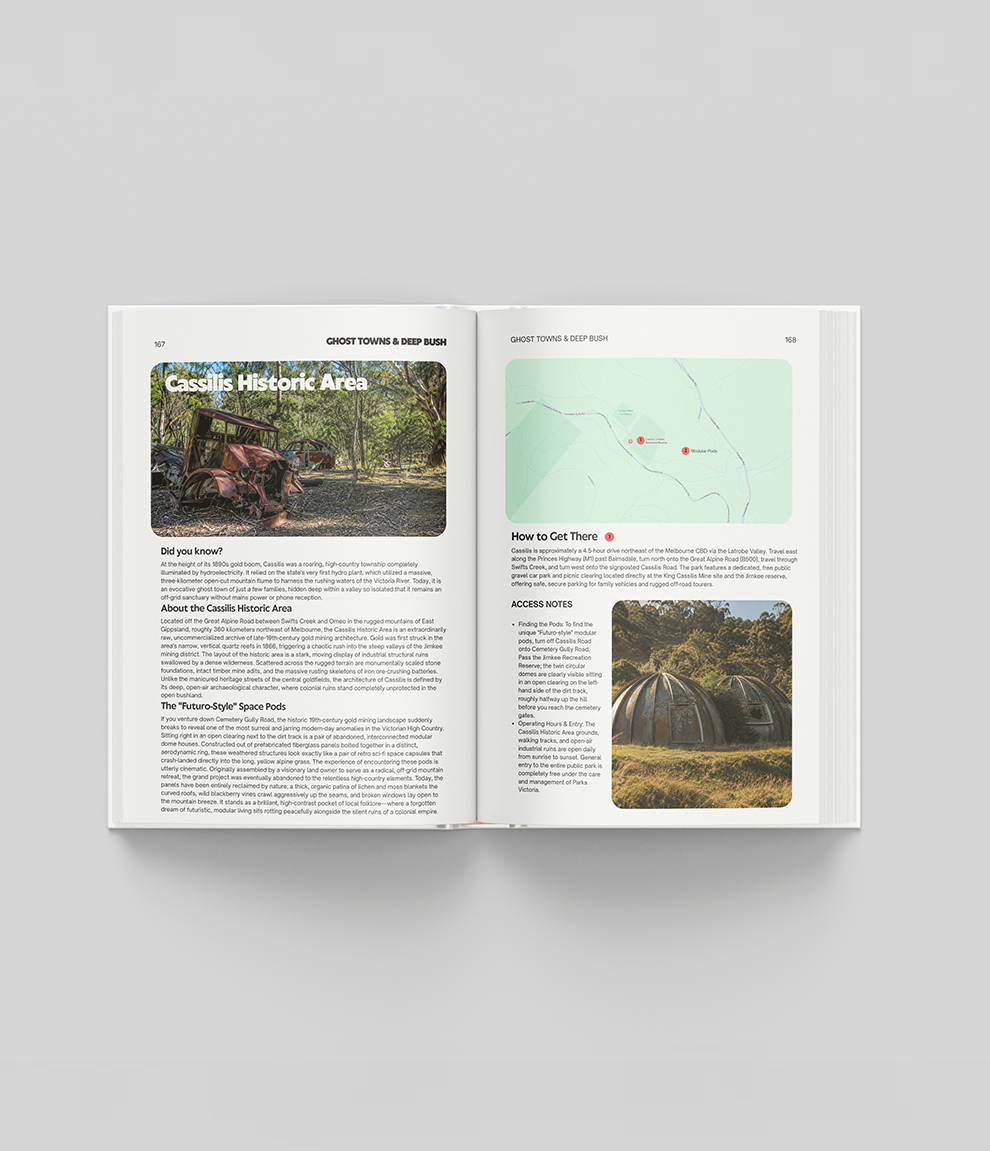
5. Cassilis Historic Area, East Gippsland
A late rush brought more than 500 people to Cassilis, high in the mountains between Swifts Creek and Omeo. To power the mines, the town got Victoria's first hydro-electric station. The mines faded, and it's now nearly a ghost town, with stone foundations, mine entrances and rusting machinery in the bush.
Can you visit? Yes, free, sunrise to sunset, on unsealed roads. It's remote, so carry water and keep well clear of old mine workings.
6. Taradale Viaduct, Taradale
Built between 1858 and 1862 to carry the railway north to the Bendigo goldfields, the Taradale Viaduct stands about 33 metres high on bluestone piers. Its wrought-iron girders were made in Wiltshire, England, with Isambard Kingdom Brunel overseeing the work, and shipped out in pieces. Steel trestles were added between the piers in the 1930s for heavier trains.
Can you visit? View it from Royal Oaks Park below. It's an active railway: never walk on the line or climb the fencing.

7. Cheviot Tunnel, near Yea
The railway kept pushing into the hills after the rush, and the Cheviot Tunnel opened in 1889 on the line to Mansfield. It runs about 201 metres through the Black Range in a lining of handmade bricks. Now it's part of the Great Victorian Rail Trail, so you can walk or ride straight through.
Can you visit? Yes, any time, free. It's unlit inside; bring a torch and give cyclists room.
8. Old Treasury Building & Gold Vaults, Melbourne
All that gold had to go somewhere. The Old Treasury Building at the top of Collins Street was finished in 1862, designed by J.J. Clark at just 19, with bluestone vaults under the street to hold bullion from the diggings. It's now a free museum telling Melbourne's story, vaults included.
Can you visit? Yes, free, Sunday to Friday 10am to 4pm (closed Saturdays).
9. Mayday Hills, Beechworth
Gold-rush wealth and gold-rush population both fed the colony's new asylums. Mayday Hills opened above Beechworth in 1867, set among oaks, cedars and conifers planted to calm patients. It's a reminder that the rush had a darker side, and the grounds now sit alongside one of Victoria's best-preserved gold towns.
Can you visit? The gardens and grounds daily; the old wards by booked history or ghost tour only.
10. Great Stupa of Universal Compassion, near Bendigo
Not gold-rush history, but the best detour on a Bendigo trip. The Great Stupa at Myers Flat is modelled on the 15th-century Great Stupa of Gyantse in Tibet and rises about 48 metres over the bush, billed as the largest Buddhist stupa in the Western world. Inside are temple rooms decorated by Tibetan artists.
Can you visit? Yes, daily 10am to 5pm, entry by donation. It's an active temple: dress modestly and take your shoes off on the temple platforms.
Planning Your Visit
Central goldfields loop (one or two days). Head up the Calder: Taradale Viaduct, then the Garfield Water Wheel at Chewton, Maldon's Beehive Mine, and on to Bendigo for the Great Stupa. Stay overnight in Castlemaine or Bendigo.
West of Melbourne. Steiglitz is about an hour from the city; time a Sunday visit if you want the courthouse open.
Further out. Walhalla is about two and a half hours east and worth a full day; arrive in time for a mine tour. Beechworth (Mayday Hills) is about three hours north-east. Cassilis is a High Country weekend via the Great Alpine Road. The Cheviot Tunnel is a short detour from Yea.
On the goldfields. Stay on marked tracks, keep kids and dogs close near old workings, never climb ruins or enter mine shafts, and don't take anything home. All ten are on the Earth Bound Explorer app map with access notes for each.
Gold Rush Towns FAQs
What is the best gold rush ghost town in Victoria?
For a near-empty town in a dramatic setting, Walhalla is hard to beat. For ruins in quiet bush close to Melbourne, try Steiglitz. Cassilis is the most remote and least changed.
Can you go inside a gold mine in Victoria?
Yes, on a ticketed guided tour such as the Long Tunnel Extended Mine at Walhalla. Never enter old shafts or adits on your own; they can collapse or hide deep drops.
Is Steiglitz free to visit?
Yes. Steiglitz Historic Park is free and open sunrise to sunset. The courthouse museum opens Sundays and public holidays.
Can you walk on the Taradale Viaduct?
No. It carries an active railway. View it from Royal Oaks Park below.