Abandoned Places in Melbourne & Victoria: 17 You Can See Legally
Victoria is full of places that have outlived their purpose: brickworks, powder magazines, gasworks, power stations, sunken ships and forts built for an invasion that never came. Some are open, some are now homes, and some are fenced off for good reason. This list is the 17 we think are worth your time, and exactly how much of each you can actually see.
Find this and dozens more in Hidden Gems Melbourne & Victoria: directions, access notes and safety tips. Printed guides include 12 months of the Explorer app free. Get the guide →
Every place here comes from Hidden Gems Melbourne & Victoria, our printed guide to the state's overlooked corners. We've been careful with access: where a site is private, dangerous or tour-only, we say so and point you to the public spot to view it from. None of this is an invitation to climb fences.

1. Hoffman Brickworks, Brunswick
The Hoffman Brickworks turned out the bricks that built boom-time Melbourne. The company started in 1870 and the works whose kilns survive today followed in 1884, with Hoffman kilns that fired bricks non-stop instead of batch by batch. Today it's a strange hybrid: the kilns have been rebuilt as apartments, while the tall chimneys still rise over the rooftops.
Can you visit? Only the public paved paths through the precinct. People live in the kilns now, so don't enter fenced areas, foyers or stairwells, don't climb anything, and keep your camera off windows.
2. University of Melbourne Car Park ("Mad Max"), Parkville
Not abandoned, but it looks the part. The South Lawn car park sits under a university lawn, held up by rows of concrete parabolic shells on short columns, designed so mature trees could grow on top. It was finished in 1972, is on the Victorian Heritage Register, and played the police garage in the first Mad Max film.
Can you visit? Yes, it's a working car park. Use the pedestrian stairs, stay in walkways, watch for cars and don't block bays.
3. The Cinema Centre, Melbourne CBD
Peter Muller's Hoyts Cinema Centre opened in 1969 as Australia's first multi-cinema complex, a heavy off-form concrete building with deep overhangs that read like an upside-down pagoda. Most of the original cinema interiors were removed around 2008 and only the main lobby survives intact, so this one is mostly about the exterior.
Can you visit? The best view is from across Bourke Street. The foyers are in daily use, so if you step inside, keep it quiet.
4. Jack's Magazine, Maribyrnong
Built in 1878 on the Maribyrnong River, Jack's Magazine stored gunpowder and explosives behind high bluestone walls and huge earth mounds meant to push any blast upward. It stayed locked away for generations, which is why the magazines, tunnels and tramway tracks survive so well.
Can you visit? You can see the walls from the public river trail. Inside is only on official open days, pre-booked tours or Open House Melbourne, run by Working Heritage. Don't try to get in any other time.

5. Bradmill Denim Mill, Yarraville
From the late 1920s the Bradmill site grew from Bradford Cotton Mills into a sprawling village of saw-tooth sheds, warehouses and a brick boiler-house chimney, and for decades it made denim for the country. After production stopped it sat empty and became famous for its graffiti.
Can you visit? No. It's now an active construction site for a new suburb, with the boiler house and other heritage buildings being restored. Look from the public street outside the perimeter fence only.
6. Newport Railway Workshops
The Newport Workshops were the Victorian Railways' great engine room, where locomotives and carriages were built and repaired. Right next door, the Newport Railway Museum keeps one of the largest collections of Victorian Railways steam locomotives, from small shunters to the giant H class.
Can you visit? The museum usually opens Saturdays 12pm to 5pm (plus some school-holiday Sundays). The working workshops are closed except on open days. Wear sturdy shoes; it's gravel and old track.
7. The Substation, Newport
Opened in 1915 to feed Melbourne's new electric trains, The Substation converted high-voltage power to the 1,500-volt current the network ran on. The railway architects treated it like a civic palace: tall arched windows, red-brick pilasters, a bluestone base. Inside, the old gantry crane still hangs over a contemporary arts space.
Can you visit? Yes. Galleries open Wednesday to Saturday, 11am to 5pm, with extra hours for performances.
8. Spotswood Pumping Station
Before 1897 Melbourne's sewage ran into gutters and the Yarra, earning it the name "Marvellous Smellbourne". The Spotswood Pumping Station, designed by MMBW engineer Christian Kussmaul, changed that. Its steam engines pushed the city's waste to the Werribee farm, and the engine house, with its brass gauges and flywheels, is a real cathedral of machinery.
Can you visit? Yes, it's inside Scienceworks and included with admission. Heritage tours run on site; check times before you go.

9. Geelong Powerhouse ("Graffiti Cathedral"), North Geelong
Geelong B Power Station opened in 1954 and closed in 1970. The empty concrete turbine halls later became one of regional Australia's best-known legal street art spaces, giving the Geelong Powerhouse its nickname, the Graffiti Cathedral.
Can you visit? Not inside. The interior is closed for structural safety and it's a privately managed site. Look at the exterior and outer murals from public land, and don't cross the boundary fence.
10. Bendigo Gasworks
Opened in 1860 and run until natural gas arrived in 1973, the Bendigo Gasworks is described by Heritage Victoria as the only coal gas plant left in the state. The retort houses, iron gasholder frames and chimney stack make it a rare, near-complete picture of how a gold-rush city got its light.
Can you visit? Only from the outside. The buildings and gasholder compound are closed; view and photograph from the public footpaths only.
11. Garfield Water Wheel, Chewton
Built in 1887, the Garfield Water Wheel was said to be the largest in the Southern Hemisphere, about 22 metres across, driving a battery that crushed quartz for gold. The timber wheel is long gone, but its two tall stone walls still stand in the box-ironbark bush of the Castlemaine Diggings National Heritage Park.
Can you visit? Yes, free, sunrise to sunset. Wear sturdy shoes on the goldfields tracks.
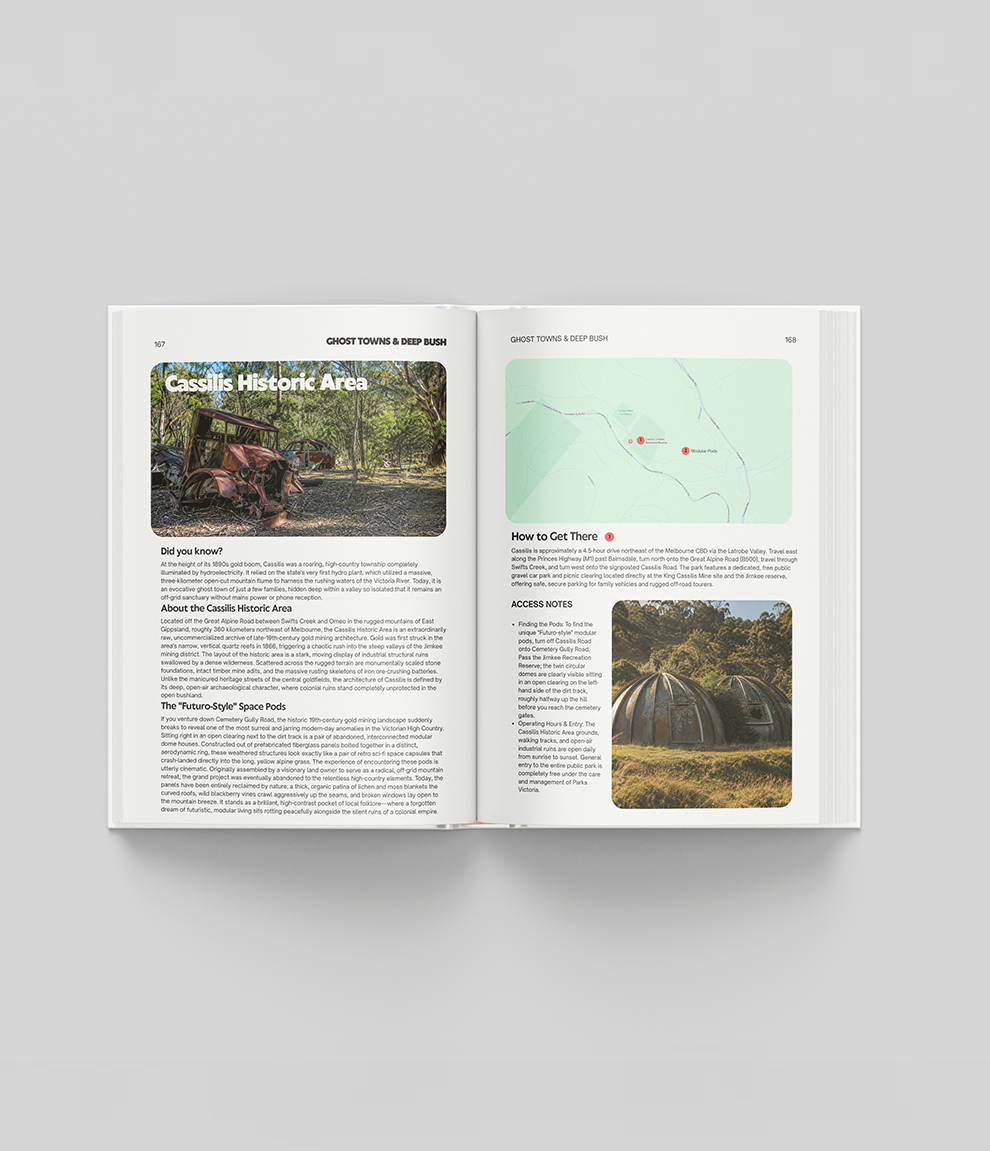
12. Cassilis Historic Area, East Gippsland
Up in the mountains between Swifts Creek and Omeo, Cassilis once had more than 500 people and the power station that first brought hydro-electricity to Victoria. It's now close to a ghost town, with stone foundations, mine workings and rusting machinery scattered through steep bush.
Can you visit? Yes, free, sunrise to sunset, on unsealed roads. It's remote, so stay clear of old mine workings and stick to tracks.
13. Cheviot Tunnel, near Yea
Opened in 1889 for the line to Mansfield, the Cheviot Tunnel runs about 201 metres through the Black Range in a lining of handmade bricks. The trains are long gone and it's now part of the Great Victorian Rail Trail, cool and echoey even on a hot day.
Can you visit? Yes, any time and free. It's unlit, so bring a torch, and share the trail with cyclists.
14. HMVS Cerberus, Black Rock
The HMVS Cerberus is the last surviving monitor-class warship in the world, built to defend Melbourne from a feared Russian attack. She was scuttled in 1926 as a breakwater and her rusting hull and turrets now sit just off the beach, slowly collapsing.
Can you visit? Only by looking. View her from the beach at Half Moon Bay. Swimming out to or climbing the wreck is prohibited, with heavy fines, and the metal is sharp and unstable.

15. South Channel Fort, Port Phillip Bay
South Channel Fort is a man-made island of bluestone, built in the 1880s to guard the bay's main shipping channel, with gun pits and underground passages kept low to the waterline. Today it's part of Point Nepean National Park and an important breeding site for white-faced storm petrels.
Can you visit? Only by boat, on a licensed tour or charter; the underground keep is licensed-tour only. Stay on the tracks, as burrows are underfoot.
16. Point Lonsdale Bunker
Half-sunk into the dunes above the Rip, the Point Lonsdale bunker is a concrete observation post from the coastal defences that watched the entrance to Port Phillip, with a long slit facing the sea. It's raw, weathered and easy to miss.
Can you visit? See it from the signposted public tracks on the headland near the lighthouse. The dunes are fragile, so stay on the tracks and don't climb or enter the structure.
17. SS Casino Wreck, Apollo Bay
The SS Casino served the western coast for 50 years before she sank off Apollo Bay on 10 July 1932, with ten lives lost. Her iron remains lie on sand in about nine metres of water, a protected historic shipwreck on Victoria's underwater heritage trail.
Can you visit? Only for experienced snorkellers or divers, in genuinely calm conditions; the safest way is with a local dive operator. Look, don't touch, and never take anything.
Planning Your Visit
Inner west on a Saturday. Spotswood Pumping Station, the Newport Railway Museum (Saturday afternoons) and The Substation are all close to the Williamstown and Werribee train lines. Add a walk along the Maribyrnong to see the walls of Jack's Magazine, and a look at Bradmill from the street.
Inner city. The Cinema Centre and the Mad Max car park are a short tram ride apart; Hoffman Brickworks is up the Upfield line in Brunswick.
Day trips. Pair the Geelong Powerhouse with Point Lonsdale. Bendigo Gasworks fits a Bendigo trip with the Garfield Water Wheel at Chewton on the way. The Cheviot Tunnel works with a ride on the rail trail from Yea. Cassilis needs a weekend in the High Country, and the SS Casino goes with a Great Ocean Road trip.
Ground rules. Stay on public land, obey signs and fences, never go in at night, and leave everything as you found it. Several of these places are people's homes or active sites now. Every spot is pinned on the Earth Bound Explorer app map with its access notes.
Abandoned Places FAQs
Is it legal to visit abandoned places in Melbourne?
Only where public access is allowed. Walking public paths, parks and streets is fine; entering fenced, private or closed sites is trespass and can be dangerous. Every place in this list includes the legal way to see it.
Can you go inside the Geelong Powerhouse?
No. The interior is closed for structural safety and is privately managed. You can view the exterior and outer murals from public land.
Where is the Mad Max car park?
It's the South Lawn underground car park at the University of Melbourne in Parkville. It's still a working car park, so stay in pedestrian areas.
Can you swim out to HMVS Cerberus?
No. Swimming to or climbing the wreck is prohibited and carries heavy fines. View it from the beach at Half Moon Bay.