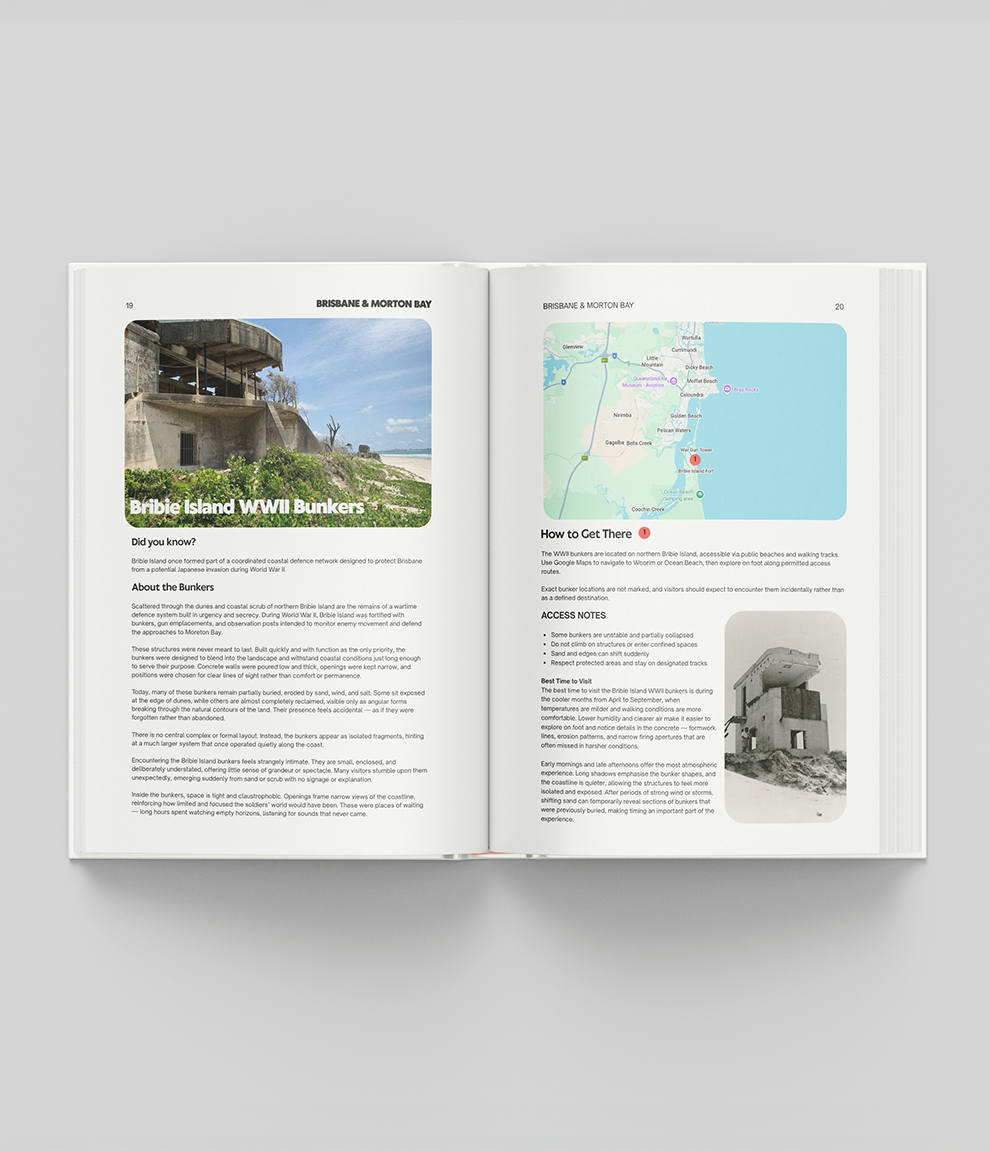
Moreton Island WWII gun emplacements: A documentary record of coastal defence

Moreton Island served as a major component of the World War Two coastal defences protecting Brisbane. Shielding the northern entrance to Moreton Bay and its vital shipping channels, the island was fortified to deter enemy naval incursions. The defensive network on the island primarily consisted of two large battery complexes: Fort Cowan Cowan on the western coast and the Rous Battery on the eastern ocean beach. Today, these remaining concrete structures offer a direct, utilitarian record of 1940s military engineering.
Fort Cowan Cowan
Commissioned in 1935 and constructed in 1937, Fort Cowan Cowan functioned as the main western defence base. The site originally housed two 6-inch coastal guns set on reinforced concrete platforms, with ammunition magazines built into the rear of the emplacements. While it remained operational until 1945, decades of natural sand movement have caused much of the facility to sink into the dunes. What remains visible are the heavy, unpolished concrete fortifications, providing a stark look at the island's early wartime infrastructure.

The Rous Battery and Civil Construction Corps track
Established later in the war (around 1943) at Toompani Beach on the island's eastern side, the Rous Battery was armed with American 155mm guns. To connect the island's scattered artillery positions, the Civil Construction Corps built a dedicated track through the native forest. During the war, this route was used to move troops, supplies, and heavy guns between Fort Cowan Cowan and the Rous Battery. Visitors can still traverse this historical track today to reach the surviving concrete battery buildings perched directly on the coastal dunes.
Accessing the ruins
The WWII remnants are located within Gheebulum Kunungai (Moreton Island) National Park and Recreation Area, requiring a high-clearance 4WD or a boat for access. There is no commercial development at these sites, leaving the concrete ruins exposed to the elements in their raw, original state. It is a necessary location for anyone building a comprehensive record of Queensland's abandoned military infrastructure.
For complete access details, navigation notes, and a comprehensive record of this site alongside other abandoned and heritage locations across the state, you can pick up a copy of the Hidden Gems Queensland guide below.